
Three Key Resources

God's Word

Jehovah God's Word, the Bible, is our primary tool for life. It should always be the first place we seek support, guidance, and direction.

Self-Guided Mental Health Skill Building

General mental health skills can be helpful for addressing many mental health issues. The lessons on this website will guide you through a course of basic CBT skills.
Professional Services

If you are experiencing significant mental health difficulties, especially if they are interfering with your daily functioning, you would likely benefit more from professional, individualized treatment. Please find a licensed, reputable mental health professional in your area or via telehealth.

If you are in crisis please call 988 or text HOME to 741-741.

If you are in crisis with negative emotions, self harming behavior or suicidal thoughts, reach out for support NOW. Crisis resources are designed to help you immediately. Don’t hesitate to seek help at your local emergency room if needed. Please follow up with a licensed mental health professional for ongoing care.

Logs and Worksheets

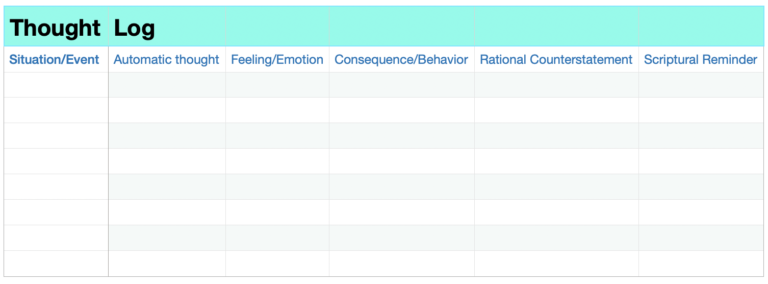
Fillable Thought Log

Track and Challenge your Thoughts and Their Effects
Situation/EventAutomatic ThoughtFeelings/EmotionsConsequence/BehaviorDistortion TypeRational CounterstatementScriptural Reminder

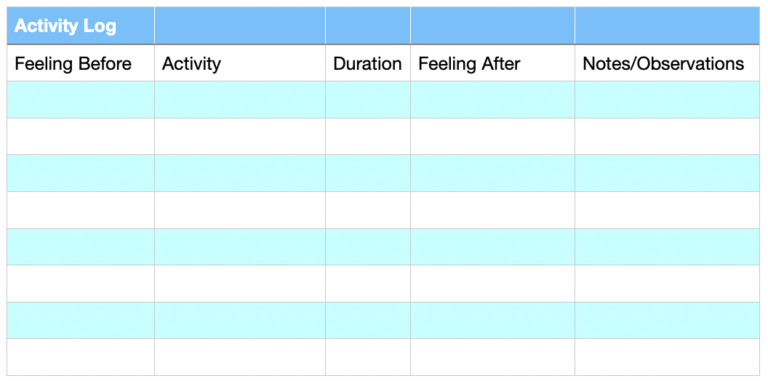
Fillable Activity Log

Track Behavioral Activation and It's Effects
Feeling BeforeActivityDurationFeeling AfterObservations/NotesScriptural Reminder

Understanding and Correcting 10 Common Cognitive Distortions

A Reference Page

1. Black and White Thinking: Embracing Gray Areas

  • The tendency to use either/or categories, such as good/bad or right/wrong, can lead to rigid thinking. Explore the gray areas in life, where complexity and growth thrive.

2. Mental Filter: The Power of Perspective

  • Recognizing mental filters. This distortion involves magnifying negative information while filtering out or disqualifying the positives. By acknowledging this tendency, you can regain control over your thoughts and focus on a more balanced perspective.

3. Mind Reading: The Pitfalls of Assumption

  • Assuming knowledge of other people’s thoughts or intentions can lead to misunderstandings and anxiety. Improve your interpersonal relationships by addressing this distortion.

3b. Fortune Telling: Uncertainty and the Future

  • Assuming knowledge and accurate predictions regarding the future is a cognitive distortion that often leads to anxiety. Manage uncertainty and reduce the impact of fortune-telling on your mental health.

4. Catastrophizing: Taming the Inner Drama

  • Catastrophizing involves your thoughts or mental imagery jumping to worst-case scenarios. Curb this distortion and develop a more realistic outlook on life’s challenges.

5. Overgeneralization: Avoiding Broad Conclusions

  • Making broad negative conclusions based on limited information or events is a common cognitive distortion. Challenge these sweeping generalizations and seek a more nuanced understanding of situations.

6. Emotional Reasoning: Your Emotions as Truth

  • Emotional reasoning is a cognitive distortion that often leads to misunderstandings. Believing that your thoughts must be true due to the associated emotional response can be misleading. Question your emotions and thoughts to gain clarity and objectivity.

7. Personalization and Blame: A Complex Web

  • Reducing the complex causations of events to either oneself or others is a distortion that often leads to guilt and resentment. Unravel this web of personalization and blame and gain a clearer perspective.

8. Magical thinking: Don’t fear the facts.

  • The belief that thoughts, feelings or emotions influence unrelated situations may create a feeling of control. However, not facing the facts can actually reduce control and coping.

9. “Should” Statements: Eradicating Self-Criticism

  • Criticizing yourself or others with “should,” “must,” or “need to” statements can create undue stress. Replace these harsh judgments with more compassionate self-talk.

10. Labeling: Breaking Free from Negative Labels

  • Assigning global negative traits to oneself or others based on limited events is harmful. Reframe these labels and foster a more positive self-image.