
Objectives:
- Understand what thought DISTORTIONS are.
- Learn how to identify which distortions are common in your thinking
- Challenge the distortion or inaccuracy with scripture.
Automatic negative thoughts are often distorted, or untrue. These distortions are so common that there are labels for different types. These labels help a person identify when his or her thoughts may be distorted or unhelpful.
(Keep in mind that here we are not discussing negative thoughts that are accurate, based on facts)
As you click on each of the following thinking errors, take note which are most common for you.
All or Nothing Thinking/Black & White Thinking
Thinking in absolutes, such as “always”, “never”, or “every”. “I never do a good job in the ministry.”
Discounting the Positive
Recognizing only the negative aspects of a situation while ignoring the positive. You might receive many compliments on an evaluation, but focus on the single piece of negative feedback.
Jumping to Conclusions
Interpreting the meaning of a situation with little or no evidence. There are two types.
Mind reading: Interpreting the thoughts and beliefs of others without adequate evidence. .”She wouldn’t work in service with me. She probably thinks I’m boring.”
Fortune telling:The expectation that a situation will turn out badly without adequate evidence. “We aren’t going to find anyone at home.”
Magnification and Minimization
Exaggerating or minimizing the importance of events. You might believe your own achievements are unimportant or that your mistakes are excessively important.
Catastrophizing: Seeing only the worst possible outcomes of a situation. “I missed a Meeting because I was sick. I’m going to be abandoned by Jehovah.”
Overgeneralization
Making broad interpretations from a single or few events. “I felt awkward at the door. I am always so awkward.”
Personalization
The belief that you are responsible for events outside of your control. “My Dad is always upset. He would be fine if I made more money.”
Magical Thinking
The belief that thoughts, feelings or emotions influence unrelated situations. “If I hadn’t thought something bad was going to happen, she wouldn’t have gotten into that accident.”
“Should” Statements
Rigid, unrealistic, and self-critical rules about how we or others “must” or “should” behave. “I should have more Bible studies.”
Labeling
Reducing a complex person or situation to a single negative, often extreme, label. “He’s a selfish Brother.”
Emotional Reasoning
The assumption that feelings reflect how things really are. “I feel like a bad Friend. I must be a bad Friend.”
How many look familiar to You?
Most people recognize several.
Now that you can identify automatic negative distorted thoughts (or stinkin’ thinkin’), what should you do?
You challenge them!
Practice with the flip cards below.
If you believe
Think of
If you think
Remember
If you believe
Remember
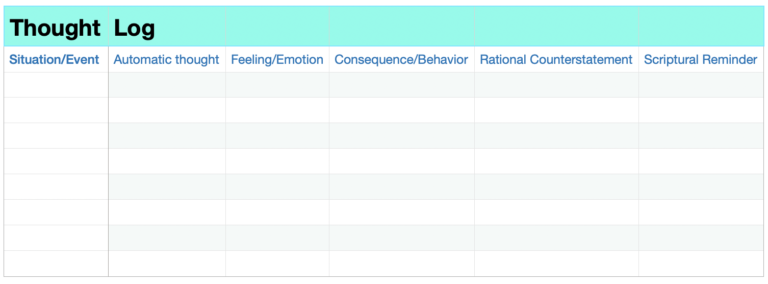
Summary: Challenging thought distortions requires you to consider the opposite of the particular distortion. To get good at identifying distorted thoughts and countering them, it is useful to write down your process. This helps encode the information in more areas of your brain, making it easier to recall.
Exercises: Complete this thought log daily each day this week.