

Objectives:
- Understand the basic principles of CBT
- Learn how thoughts, feelings, and behaviors are interconnected.
- Examine the role of Scripture in renewing the mind.
- Emphasize how CBT complements one’s faith and encourages positive behavior aligned with Biblical principles.
What is CBT?
As is often the case, ancient Bible wisdom was later “proven” by secular scientists. In the book of Romans, Paul wrote to encourage the Roman congregation to step out of the world’s thinking and living, and “be transformed by making your mind over” with Jehovah’s thinking. Paul knew from experience that changing one’s thinking to be in line with Jehovah’s could be nothing but beneficial for every person.
Although not spiritually based, in the 1960s Cognitive Therapy also highlighted the benefits of changing one’s perspective by challenging negative thoughts. Over time, Cognitive Therapy developed further into Cognitive Behavioral Therapy and CBT has become one of the most effective treatments for many mental health issues.
Over the decades, an abundance of research continues to show how well CBT works for a number of common mental health problems.
The premise of CBT is that thoughts, feelings and behavior are all connected, and that individuals can move toward overcoming difficulties and meeting their goals by identifying and changing unhelpful or inaccurate thinking. A person can also change problematic behavior and distressing emotional responses, both of which often stem from inaccurate thinking.
This diagram shows the interdependent relationship of thoughts, feelings and behaviors.
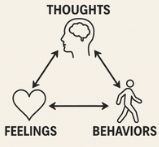
What is meant by interdependent? Please notice that all the arrows are double-sided. This highlights that as thoughts can influence feelings and behaviors, so too can feelings influence thoughts and behaviors, and behaviors can influence thoughts and feelings. To simplify, allow me to share an illustration.
Consider this scenario.
One day, a Brother wakes up after a poor night’s sleep worrying. He feels tired and irritable. When the Brother takes out his cereal for breakfast, he spills it all over the floor. He thinks negatively, “It’s going to be one of those days where everything goes wrong.” Then, as he walks outside, his neighbor accidentally bumps into him. The Brother reacts with anger and unknowingly gives the neighbor a dirty look (behavior).
Whoa! Our poor Brother. That does seem like a bad start to his day.
Now lets reimagine the same scene, but the Brother ended the night before with personal study and fell asleep feeling grateful to Jehovah. He wakes feeling refreshed and happy and says a prayer of thanksgiving and commitment to Jehovah. The Brother spills his cereal, yes, but rather than thinking negatively, the Brother thinks, “I’m glad I didn’t spill the milk- that’s harder to clean up!” Finally, as he walks outside, his neighbor accidentally bumps into him. The Brother reacts (behavior) with happiness at seeing the neighbor and forgiveness for the bump, knowing it was unintentional.
This is quite a different sequence of events, although the same potentially negative things happened to our Brother in both morning scenarios.

When we dissect each scenario, we see how the Brother’s negative thinking (worry) or positive thinking (gratitude) influenced his behavior (trouble sleeping vs good sleep). This influenced his feelings (tired and irritable vs refreshed and happy), which influenced his thinking (it’s going to be a bad day vs it could have been worse). His thinking then influenced his feelings/mood (grumpy vs happy), which in turn influenced his behavior (mad at the neighbor vs happy to see the neighbor).
This interaction of thoughts, feelings, and behaviors goes on all day long, often outside of our consciousness. However, if we learn to pay attention to these components, we can gain control of how they influence us. We can then bring them in line with Jehovah’s principles.
How does Jehovah want us to think, feel and act?
In our study of the Bible, we learn of Jehovah’s cardinal qualities: Wisdom, Justice, Power and Love. Jehovah wants us to understand his wisdom and justice and what represents Godly power and love.
It is clear that Jehovah wants us to be happy and loving, in reflection of himself and his son. We are God’s happy people!
SUMMARY: Coming to know Jehovah’s thinking helps us gain his perspective, which is loving, hopeful, just, and takes into account “the big picture” of Jehovah’s purposes. Knowing this, we imitate what we can- being hopeful and loving. These positive qualities help us reframe negative thinking patterns, which we will examine in the next module.
Exercises:
-
- Journal your thoughts, feelings, and behaviors from a recent stressful situation. Remember thoughts are the sentences that go through our mind. Feelings can be emotions or bodily feelings. Behavior is what we do, our actions.
-
- Reflect on a single scripture about the Hope Jehovah gives us. Then, consider how focusing on positive, accurate thoughts can impact emotions and behavior.